
An Overhead Stirrer is often the preferred mixing solution when sample volumes increase or liquid viscosity exceeds the capabilities of a magnetic stirrer. Laboratories across South Africa use Overhead Stirrers for applications ranging from reagent preparation and biotechnology research to paint formulation, polymer mixing, and cosmetic development. Selecting the correct Overhead Stirrer can improve mixing efficiency while helping users achieve more consistent and repeatable results, particularly when working with larger volumes, viscous liquids, suspensions, and emulsions.
As a laboratory supplier and distributor of laboratory equipment in South Africa, Vertex Analytical offers affordable Overhead Stirrers designed to support a wide range of laboratory and industrial mixing applications. To see our Overhead Stirrers in operation and learn more about their features, applications, and mixing capabilities, explore our laboratory equipment videos and educational content on our YouTube and LinkedIn channels.
Why an Overhead Stirrer Is Different
Unlike magnetic stirrers, an overhead stirrer uses a motor-driven shaft and paddle to generate mixing force directly within the sample. As a result, it can handle larger volumes and more viscous materials with greater effectiveness.
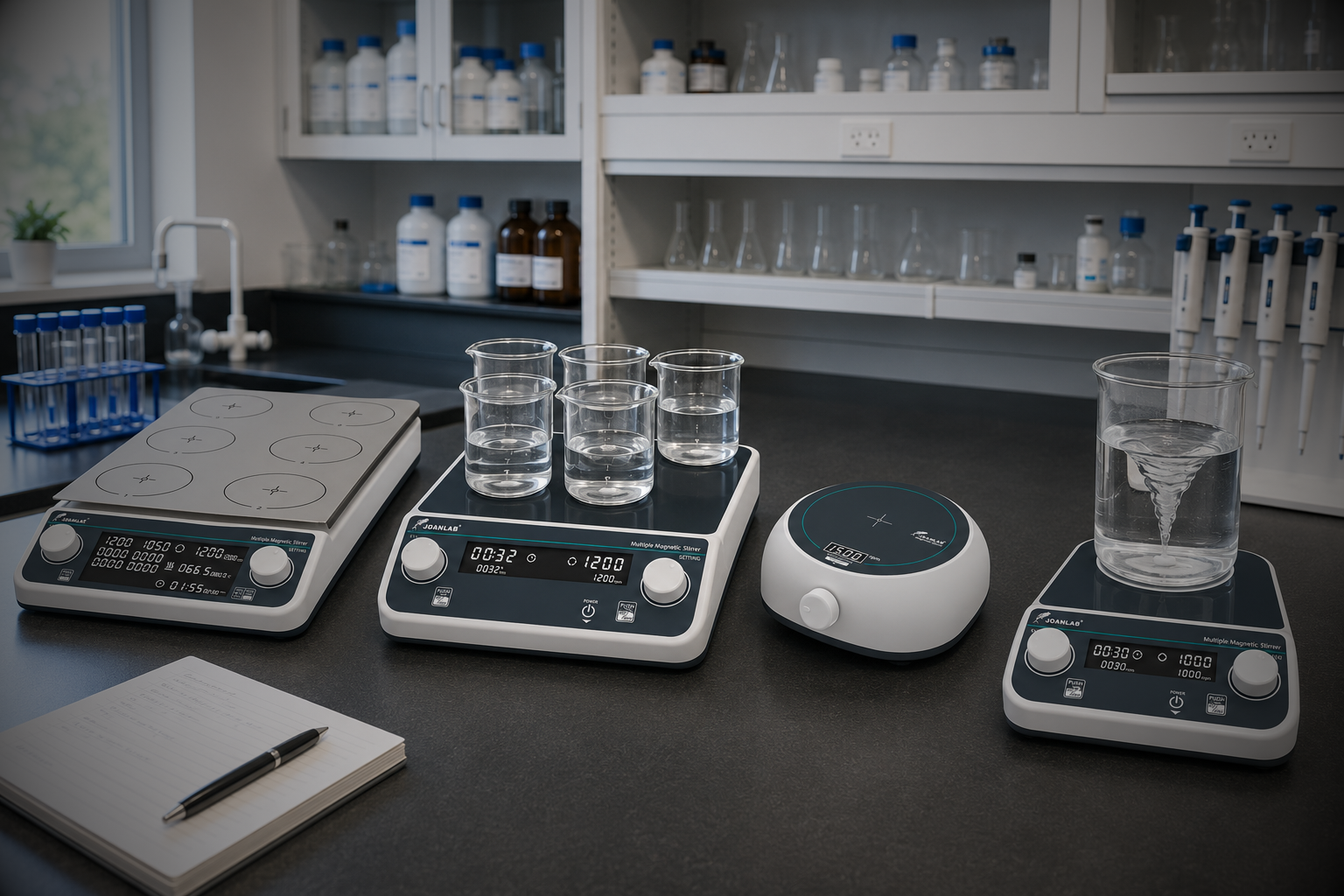
For example, a magnetic stirrer may perform well with water-based solutions and simple buffers. However, once a sample resembles syrup, paint, creams, emulsions, or resins, an overhead stirrer often becomes the more practical choice.
Another important factor is torque. While many users focus on RPM, torque is usually the key specification when working with thicker samples. Higher torque allows the stirrer to maintain rotation even when resistance increases during mixing.
Understanding Viscosity and Mixing Requirements
Before selecting an overhead stirrer, it is important to understand the viscosity of the sample. Viscosity simply refers to how easily a liquid flows.
Water has very low viscosity, while paint, creams, and gels have much higher viscosity. Consequently, high-viscosity applications typically require more torque and often operate at lower speeds.
When discussing requirements with customers, it can be helpful to compare the sample to familiar materials such as water, cooking oil, syrup, paint, or peanut butter. This approach often provides enough information to identify a suitable stirring solution.
Features That Improve Laboratory Productivity
Modern digital overhead stirrers offer more than simple speed control. Many models include programmable timers, digital displays, brushless motors, and optional temperature monitoring capabilities.
Brushless motor designs are particularly useful in busy laboratories because they require less maintenance and provide stable speed control during extended operation. In addition, some advanced models allow the stirring shaft to pass through the motor housing, making paddle height adjustment faster when working with different vessel sizes.
For laboratories handling aggressive chemicals, PTFE-coated paddles may also provide improved chemical resistance compared to standard stainless-steel options.
Finding the Right Mixing Solution
Whether you work in research, pharmaceutical development, food testing, environmental analysis, or industrial manufacturing, selecting the correct overhead stirrer starts with understanding sample volume, viscosity, and torque requirements.
At Vertex Analytical, we supply affordable laboratory equipment throughout South Africa and assist customers in selecting practical solutions for their applications. You can also explore our Overhead Stirrer product pages and visit our Insights section for additional information on laboratory techniques, accessories, and best practices.
For product demonstrations, application discussions, and laboratory equipment updates, follow Vertex Analytical on LinkedIn and subscribe to our YouTube channel. If you are evaluating mixing equipment for your laboratory, contact Vertex Analytical to learn more about our Overhead Stirrer range and request a quotation.