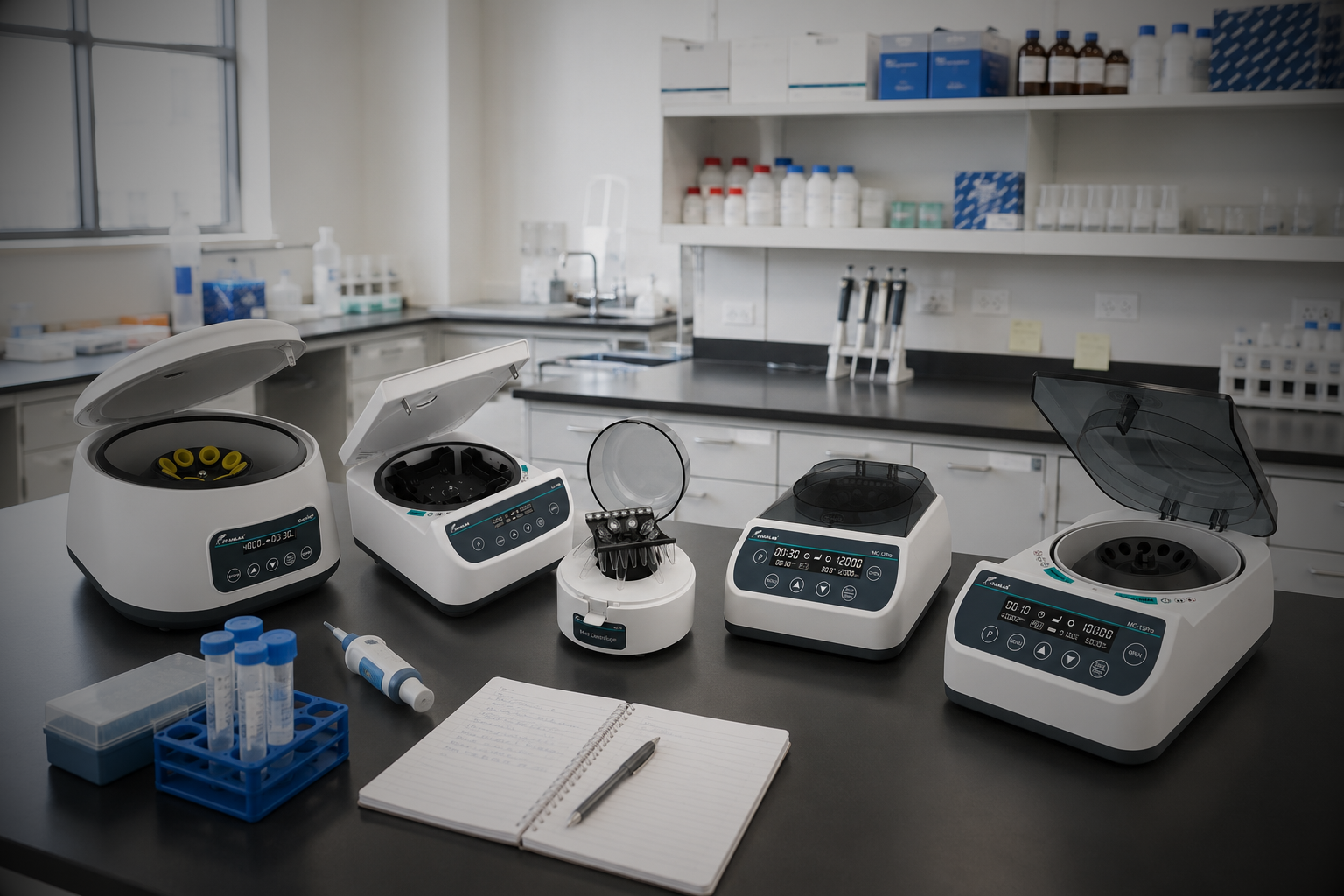
Centrifuges remain essential tools in research, clinical, industrial, and educational laboratories across South Africa. From routine blood separation to PCR preparation and sample clarification, these systems support fast and reliable sample processing in a compact laboratory footprint. Laboratories can select from a Mini Centrifuge for rapid spin-down applications, a Micro Centrifuge for high-speed processing of microcentrifuge tubes, a Clinical Centrifuge for routine blood and clinical sample preparation, or a Benchtop Low Speed Centrifuge for larger volume tubes and general laboratory workflows. Based on the centrifuge concepts outlined in the supplied cheat sheet, selecting the correct centrifuge depends on more than speed alone, with rotor compatibility, sample volume, throughput requirements, and application suitability all playing important roles.
At Vertex Analytical, scientists and procurement teams can source affordable laboratory equipment designed for practical laboratory workflows. As a laboratory supplier and distributor in South Africa, Vertex Analytical supports laboratories that require economic solutions without unnecessary complexity. To see these centrifuges in operation and learn more about their applications, explore our product demonstration videos and laboratory equipment content on our YouTube and LinkedIn channels.
Why Mini Centrifuges and Microcentrifuges Matter
Mini Centrifuges and Microcentrifuges are commonly used for small-volume applications involving PCR tubes, microcentrifuge tubes, and quick spin-down procedures. These compact systems help laboratories improve workflow efficiency while reducing bench space requirements.
Importantly, centrifugation works by separating sample components according to density. During operation, heavier particles move outward while lighter components remain closer to the rotor centre. Therefore, understanding RPM and RCF remains critical when selecting a centrifuge. Although RPM measures rotor speed, RCF determines the actual force applied to the sample.
Many laboratories also prefer brushless motor technology because it reduces maintenance and supports quieter operation. In addition, lid lock safety systems help protect users during high-speed operation.
Clinical Centrifuges and Benchtop Low Speed Centrifuges in South Africa
Clinical Centrifuges and Benchtop Low Speed Centrifuges are widely used in pathology laboratories, universities, industrial laboratories, and healthcare environments throughout South Africa. These centrifuges commonly process blood tubes, conical centrifuge tubes, and microplates.
When selecting a centrifuge, laboratories should confirm:
- Tube size and tube type
- Required RCF or RPM
- Rotor compatibility
- Capacity requirements
- Noise considerations
- Digital control requirements
- Fixed angle rotor compatibility
Fixed angle rotors remain popular because they support faster pelleting and routine laboratory applications. However, tube compatibility remains equally important. Incorrect tube dimensions or unsuitable RCF ratings may lead to imbalance, tube rupture, or rotor damage.
Practical Laboratory Considerations
Laboratories processing temperature-sensitive samples such as RNA, DNA, proteins, or cells may require refrigerated centrifugation. However, many routine laboratory applications can be handled efficiently using Mini Centrifuges, Microcentrifuges, Clinical Centrifuges, and Benchtop Low Speed Centrifuges.
To explore additional laboratory equipment, visit the Vertex Analytical centrifuge product pages, follow updates on LinkedIn, or view application content on YouTube. As a trusted laboratory supplier and distributor in South Africa, Vertex Analytical continues to provide affordable and economic centrifuge solutions for research, clinical, and industrial laboratories.